How Often to Post on TikTok: More Growth, Less Guesswork
Learn how often to post on TikTok with a practical test for creators and businesses. Find out when extra posts earn more reach, followers, or leads.
On this page
How often to post on TikTok: the real decision
More TikTok views can hide a worse return on your time.
You add two posts a week. Total views rise. Yet your best series gets rushed, fewer viewers follow, and the extra hours produce no new leads. You’re posting more and getting less for it.
The short answer
If you already post on TikTok, use your current pace as the starting point. Test one or two extra weekly posts before making daily posting a permanent commitment. Keep them only if the whole schedule earns enough extra value.
If you have no track record, three to five weekly posts is a workable first test, provided you can sustain it. That’s a planning range. Nobody has found a proven TikTok sweet spot.
What You’ll Learn
- Which problem more posts can solve, and when volume won’t help.
- How to test frequency without letting a viral hit or old videos skew the result.
- How to price the extra work against growth, leads, and other uses of your time.
- When to keep daily posts, cut back, or use a short burst.
What posting frequency advice actually tells you
TikTok’s own guidance has included very different ranges:
| Source | Advice | What it can tell you |
|---|---|---|
| Older Organic Playbook | Two to three posts a week, with quality first | A lighter pace is a valid starting approach |
| Older business creative guide | One to four posts daily to test different content | More volume can support more tests when you have the capacity |
| Current recommendation guide | Describes viewer actions, content details, and other signals | It sets no universal daily quota or fixed gap between uploads |
Those ranges serve different goals. Neither proves what your next post will earn.
TikTok’s current audience growth guide calls for high quality posts on a regular basis, without setting a daily quota.
Industry averages won’t settle it either. Accounts that publish more may have larger teams, stronger formats, or more reach already. A link between higher volume and better results doesn’t tell you how much the extra uploads caused.
Use those numbers to choose a test. Use your results to choose a schedule.
Give the extra TikTok posts a specific job
Before increasing frequency, name what the added slots should change. Otherwise, it’s easy to keep uploading because the calendar says so.
| Your situation | Job for the added posts | What would justify keeping them? |
|---|---|---|
| Results vary and few formats work more than once | Test distinct ideas faster | You find a format that works again on a fresh topic |
| A proven series has more demand than available slots | Serve more of that demand | Added growth with regular posts holding up |
| A launch or event creates short lived demand | Answer timely questions | Useful reach or sales during the window |
| Views rise, but follows or leads stay flat | Diagnose the weak step first | More posts would need to reach people likely to act |
For tests, name the decision each post should inform. “Will price comparisons bring better leads than product demos?” gives you something to learn. “Post more behind the scenes” gives you more footage.
Set a review date for those test slots. A weak post can reveal a useful next move. A month of extra uploads with no change in your choices is harder to justify.
If your problem is choosing an audience or content direction, use the TikTok growth strategy guide. Posting frequency decides how much space those choices get.
Choose a starting schedule for the job
These are examples to test, not platform rules:
| Weekly pace | Example allocation | Main reason to use it |
|---|---|---|
| Three posts | Two proven slots, one test | Each video takes substantial work |
| Five posts | Three proven slots, two tests | You want faster learning without daily output |
| Seven posts | Keep five regular slots, add two | You have evidence that more demand is worth serving |
| More than seven | Keep regular slots, add selected second posts | You have timely replies, separate ideas, or a defined burst |
A “proven slot” means a format that has worked across several posts. One breakout isn’t enough to treat a format as reliable. With no proven formats yet, treat the first schedule as a test throughout.
Find the cost of the next post
Your average production time can hide the cost of increasing output.
The first demo uses footage you already have. The next needs a fresh setup. The one after that delays your main weekly video. Those posts don’t cost the same amount of effort.
Compare total work at the current pace with total work at the higher pace. Include filming, edits, research, replies, and any paid help. Shared filming may make added posts cheap. Extra shoots may make them expensive. Our podcast clip promotion example shows how one recorded episode can supply three separate posts.
Protect the work that already earns results
Set limits before adding slots:
- Keep the preparation time for your strongest series.
- Keep time to answer comments and sales questions.
- Leave room to review results before planning the next batch.
If extra posts take time from those jobs, record it. You’ll need that context if your regular posts weaken.
A higher pace can also drain finished work while hiding a production shortfall:
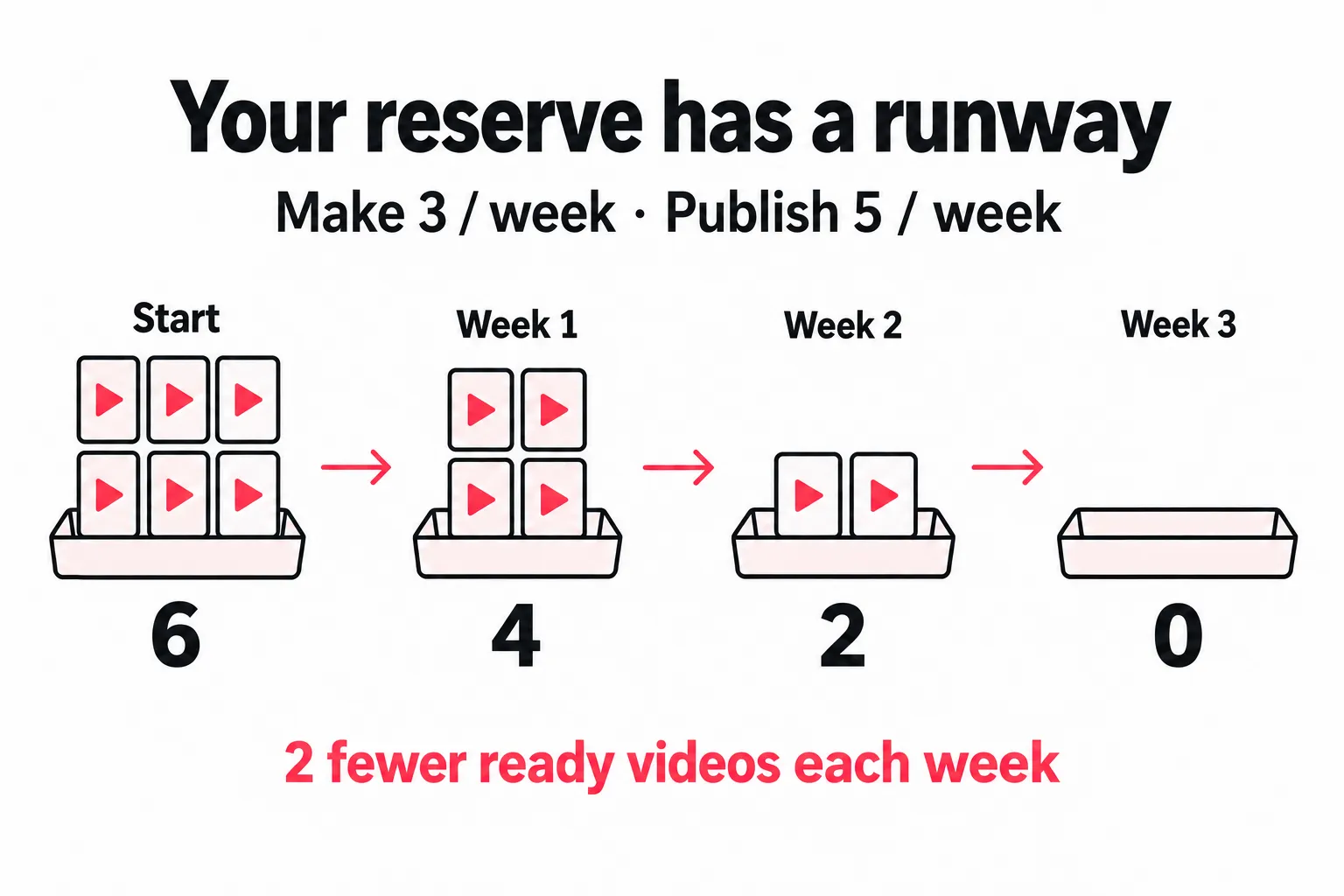
Use a reserve to cover a launch or busy period with a planned end date. Set your normal frequency from the work you can replace.
Creator tools can help schedule uploads, though features vary by surface. Scheduling decides when a video goes live. It won’t give you more good videos to post.
For added topics, Creator Search Insights can reveal search demand with gaps in available content, where the feature is offered. Use the keyword research guide to assess those ideas before filling slots.
Run a posting frequency test you can trust
You won’t isolate every factor that affects reach on one account. Aim for a decision you can act on.
1. Set the goal and the limit
Choose one main outcome: reach, follows, qualified leads, or a clear learning goal. Define a qualified lead for your business, such as someone asking about a service you offer in an area you serve.
For a concrete schedule, see our small business promotion example. It uses two videos a week to show finished work, answer buying questions, and explain how to request a quote.
Then set the smallest gain that would make the work worthwhile. For example:
“Near their usual results” needs context. Look at several recent, normal periods of the same length. If your total usually swings by 30 follows, a gain of 20 is weak evidence. You may need another round before committing.
2. Keep a clear comparison
Start with two weeks at your usual pace, then two weeks with the added slots. Use complete weeks so both periods include the same weekdays.
Keep regular slots similar in topic, length, format, and time. TikTok Studio can show viewer activity to help choose times, if your account has that data.
Decide what you’re testing:
- More of the same work: add similar formats to learn whether extra volume helps.
- A new schedule and content mix: add, for example, two short replies alongside five demos. You’re testing that combined change, so don’t credit frequency alone.
Record launches, trends, collaborations, and paid promotion. A product drop in the second period can make a higher pace look better for reasons that won’t repeat in a normal week.
If the result is close, repeat the comparison. Returning to the old pace can provide another check, but audience growth and older posts still carry over. It’s a field test, so it can’t prove cause.
3. Separate new post results from account totals
Use two views of the results:
| View | What to record | What it helps answer |
|---|---|---|
| Posts published during each test period | Each post’s results at the same age | Did this set of new uploads perform better? |
| Whole account during each calendar period | Total growth, leads, sales, and work | Did the business or account gain enough overall? |
Don’t mix them. A tutorial from last month may drive this week’s followers. That growth matters, but it doesn’t belong to the new schedule’s posts.
For the post comparison, pick an age such as seven days. Wait until the final upload reaches it before reviewing the full set. Add a later check, such as 28 days, if search brings meaningful results long after publishing.
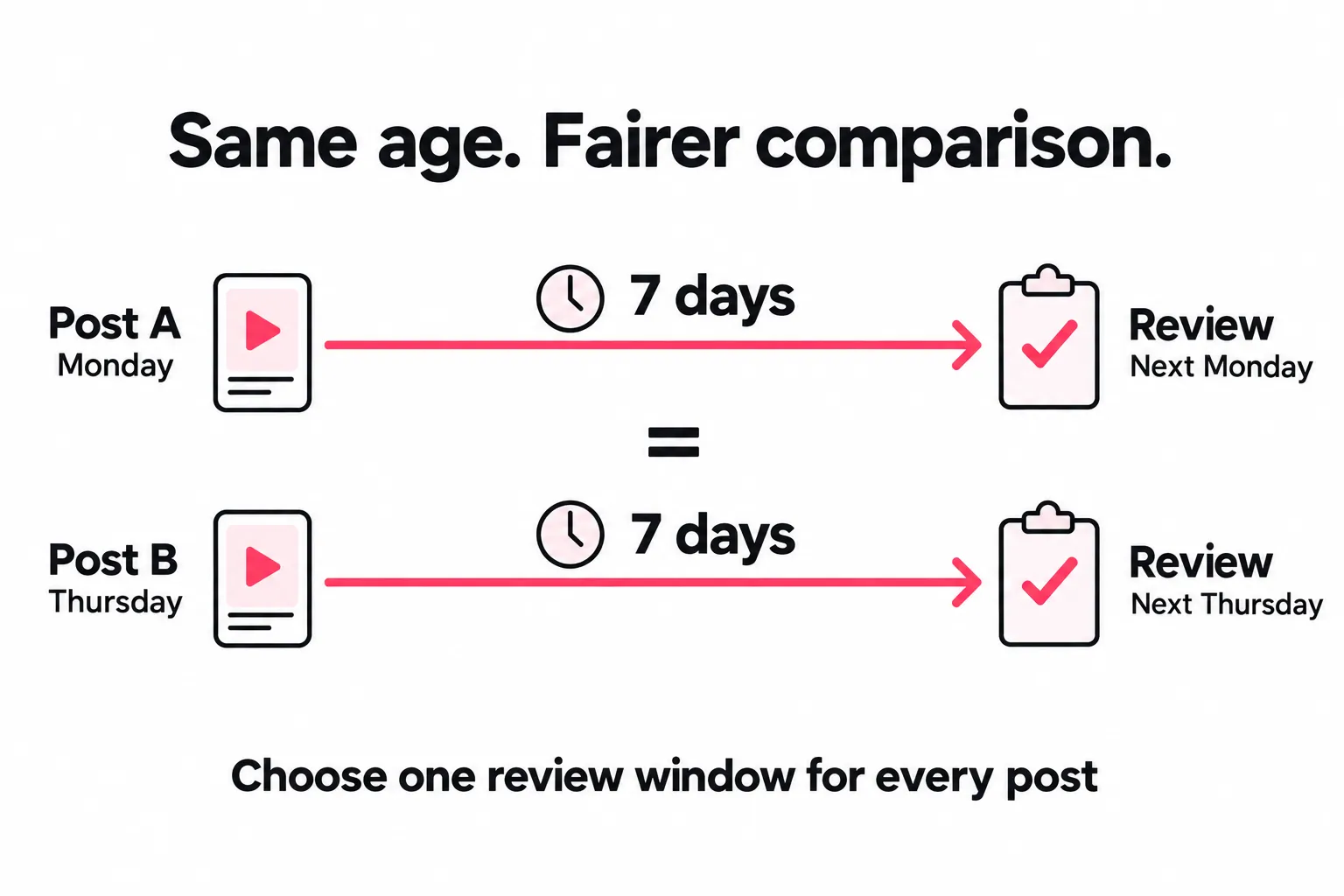
TikTok’s older creator tips also advise allowing time before judging a new upload.
4. Record only what can support the decision
Use one row per post:
| Field | Why it matters |
|---|---|
| Regular or added slot | Shows whether extra work helped or displaced results |
| Topic, format, length, and publish time | Lets you compare similar work |
| Review date and post age | Prevents an unfair head start |
| Views and follows, where shown | Tracks reach and follower growth separately |
| Watch time or completion, where shown | Helps explain a change in similar videos |
| Work time and paid costs | Shows what the result took to produce |
| Launch, promotion, or other unusual event | Flags results that may not repeat |
Keep leads in a separate log. Count a person once per inquiry, and record which video led them to you only when you know. Keep unknown sources marked unknown. Don’t turn account follower changes into invented per post results.
Judge the whole schedule, including what it lost
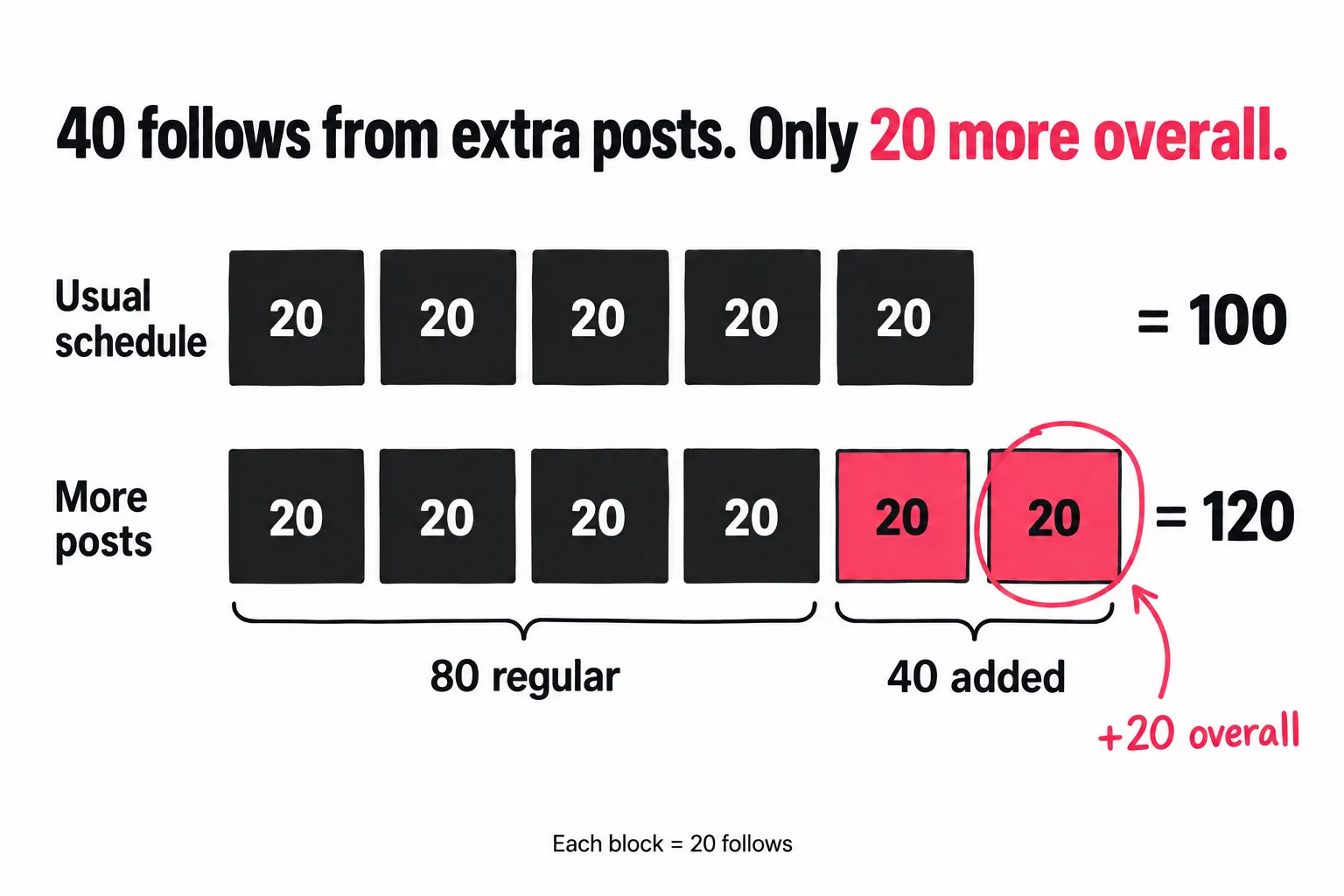
Here is a fictional comparison of five versus seven posts a week. Each pace runs for two weeks. Follows are measured seven days after each upload. These are results from the new posts, not net account growth.
| Measure | Five a week | Seven a week |
|---|---|---|
| Regular posts | 10 | 10 |
| Added posts | 0 | 4 |
| Follows from regular posts | 100 | 80 |
| Follows from added posts | 0 | 40 |
| Total reported follows | 100 | 120 |
| Total work | 14 hours | 20 hours |
The added posts earned 40 follows. The whole schedule gained only 20 because the regular posts earned 20 fewer.
That doesn’t prove the new posts stole reach. Rushed production or a weaker batch of topics could explain the drop. Either way, 40 overstates what the schedule gained.
Extra results per added hour = change in total results ÷ extra hours worked.
Here, 20 ÷ 6 is about 3.3 extra follows per hour. The schedule met the example growth target but exceeded its four hour limit.
The decision is now specific: reduce the extra work, accept a higher cost for that growth, or return to five posts. Compare those six hours with your next best use of them, such as improving a proven series or handling sales inquiries.
If the higher pace takes the same time, compare results directly. If it saves time, keep that benefit in the decision too.
You can also test a different use of those hours: getting the existing videos in front of more relevant people. How many videos you make and how you get them seen are separate decisions. Finish the frequency test before changing how you bring viewers to each post.
For a business, work backward from lead value
Use your own sales history to set a rough spending limit for added posts.
Suppose one in five qualified leads becomes a customer, and each sale leaves $100 after the costs of fulfilling it. The expected value per lead is $20 before content costs. Six extra hours valued at $30 each cost $180.
That means nine extra qualified leads would only cover those hours. Add any editing fees or other costs before setting your target. These figures are made up, and a small batch of leads can close very differently from your average.
You don’t need a precise dollar value for every follower. For creators, a time limit plus a growth or learning goal can be more useful than a made up price per follow.
Know which result deserves another test
A single total can hide several different outcomes:
| What happened | What to check next |
|---|---|
| Average views fell, total reach rose | Did total follows or useful leads also rise enough to justify the work? |
| Added posts did well, regular posts weakened | Check lost preparation time, topic changes, and replies before adding more |
| Total views rose, follows or leads stayed flat | Hold frequency and check audience fit or the next step after viewing |
| One breakout drove the gain | Compare the result with and without that post before raising normal output |
| New uploads stayed flat, account growth rose | Check whether older videos or a launch drove the gain |
| Results improved, but the time cost missed your limit | Try a cheaper added format or keep the old pace |
Keep breakout posts in your actual total. Then remove the largest result from each period for a second look. If the preferred schedule changes, the choice depends heavily on the strongest posts. Repeat to see whether that pattern holds.
More uploads give you more chances to publish a hit. They also cost more. One hit may justify that month’s work without proving that every month should follow the same schedule.
Check the median result within similar formats as well. A lower median with a higher total may still suit a reach goal. It may suit a business less well if leads come mainly from the steady series you’ve displaced.
If the weak step is follower growth after viewing, use the views but no followers guide. A broad reach drop belongs in the views dropping guide.
Posting twice a day and using short bursts
A weekly total doesn’t describe the full schedule. Seven videos spread across seven days is a different test from seven videos packed into three.
To test a second daily post, keep your regular slot. Add a second on selected, comparable days. Give it a distinct job, such as answering a buying question raised by the first video. Review both slots and their combined result.
There is no fixed spacing rule in TikTok’s recommendation guide. Choose times that suit your viewers and leave room to respond. Hold those times steady while testing.
For a launch or viral follow up, set the burst’s end point in advance: the offer closes, the event ends, or the key questions are covered. Review its results against that event’s goal. If a post takes off, our guide to going viral on TikTok helps you choose the follow up.
A burst that works during unusual demand doesn’t establish your normal posting frequency. Afterward, return to the regular pace and rebuild any reserve you used.
Give each post a route to new viewers
Suppose five weekly videos bring useful questions and follows, but seven stretch your time without adding much. The next test could keep those five videos and change how people find them.
Ask yourself what happens after you publish. TikTok tests each new post on a small group before deciding how far to push it (how that first test works), so the first hours matter most. If the answer depends on spare time or a promising first hour, distribution will vary even when your posting schedule stays steady.
Keep the original video as the destination
When sharing a specific answer, link to that TikTok rather than making people search your profile for it. A mug care video shared in a customer email should open the care video. Readers can watch, ask questions, and explore your profile from there. For a step-by-step version, use this first-hours launch checklist.
For people beyond your own audience, another route is ad placements across mobile apps and sites that lead to the original post. Someone sees the placement, and if they’re interested, they tap through to the video on TikTok.
The original post stays the place where people watch and respond. You’re adding a distribution step to a video you’ve already finished, without using a new publishing slot.
Set the rules before the next upload
Keep the routine specific enough to repeat. For a small reach test, write down:
- Which posts qualify: choose the next few videos in a defined series, with clear reasons to skip one.
- Where viewers should come from: use places your audience already visits. For paid placements, choose a country you can serve.
- What each post can cost: set a budget per video and a total limit for the test.
- When to review: use the same post age and record when outside distribution began.
This makes the work easier to hand off or automate. A new public upload can trigger a separate campaign under those rules, with an option to skip a post. You decide the process once instead of rebuilding it after every upload.
Learn which sources send real viewers
Keep spend and delivered traffic in a separate report for each video. Then compare those records with what happened on TikTok.
Over several posts, those records show which sources send people who actually watch and respond. Move your effort and budget toward them, and the routine gets sharper with each post. If a video doesn’t fit its audience, fix the video first. More traffic won’t solve that.
The payoff is more exposure from a schedule you can keep. Every post gets fresh viewers while TikTok is still deciding how far to push it, and you don’t add another upload to your week.
Before adding production or distribution, finish this sentence: “This extra work needs to produce ___, within ___ hours and ___ budget, without weakening ___.” Use the answer to choose which lever deserves the next test.
Frequently asked questions
How often should I post on TikTok to gain followers?
Use your current schedule as the baseline, then test one or two extra posts each week. With no track record, three to five weekly posts is a workable starting test. Treat it as a planning range. No one has shown it's the best pace for follower growth.
Compare follows from all posts at the same age, including your regular uploads. Keep the higher pace if it adds enough followers to justify the extra hours. More views alone don't answer that question.
Do you really need to post on TikTok every day?
No. TikTok's public guidance doesn't say you must post daily to grow. A daily schedule is worth testing when you have enough distinct ideas and can keep the work that already earns results.
Judge the extra days by what they add. If daily output cuts into your strongest series or time spent answering buyers, compare that loss with the added reach, follows, or leads before committing.
Should I post two TikToks in the same day?
Test a second post when it has a clear purpose, such as answering a question raised by the first. Keep your usual slot and add the second on comparable days. If you change the format too, you're testing that combined change.
Check both posts at the same age and compare their combined results with similar days with one post. A lower average per video can still mean more total growth. A weaker first post doesn't, by itself, prove the second stole its reach.
How long should I wait in between posting TikToks?
TikTok's recommendation guide gives no fixed waiting period between uploads. The popular three-hour and 24-hour waiting rules don't appear in it.
Choose two slots based on viewer activity and when you can handle replies. Keep those times steady while testing. Review each post after the same number of days instead of judging it by its first hour.
Is it bad to skip a day of posting on TikTok?
Skipping a day costs you one upload. TikTok's public recommendation guide describes no penalty for breaking a daily posting streak.
Resume your normal schedule instead of cramming extra posts into the next day to make up the count. If missed days keep happening, lower the planned pace or build a reserve. Compare complete weeks before deciding whether your growth has changed.