
TikTok Keyword Research: Find the Phrases Your Buyers Type
A working method for TikTok keyword research. Where real search phrases come from, the four kinds of search, how to score a phrase, and where to place it.
On this page
What TikTok keyword research gets you
Search is the one place on TikTok where the viewer tells you what they want before they press play, and most creators still film like it doesn’t exist.
Everyone reads the For You feed. It’s loud, it’s fast, and it’s where the big numbers come from. But the feed has no memory. It shows your video for a couple of days and moves on to the next thousand.
Search has a longer memory. When someone types “how to fix dry rice” into the search bar, they’ve handed you the exact topic. You aren’t fighting a trend for attention. You’re answering a question that’s already in someone’s head.
TikTok keyword research is how you find those questions, decide which ones deserve a video, and put the phrase where TikTok can read it. Do it well and a video keeps pulling in views long after the feed has forgotten it.
One warning before we start. TikTok keyword research does not work like Google keyword research. There’s no clean volume number waiting for you and no tool that hands over a list you can trust. You build the list yourself, then test each phrase before you spend a day filming the wrong thing.
So what is TikTok keyword research, really?
It’s finding the phrases your viewers type into the TikTok search bar, working out which ones can actually win you views, and putting those phrases where TikTok can read them.
It isn’t hashtag collecting. Hashtags are the weakest part of this, and a small one.
What you’ll walk away with
- The five free places real TikTok keywords come from
- The four kinds of search, and the video each one needs
- A scoring model that tells you what to film today
- The four places TikTok reads your keyword, ranked by pull
- A five minute test that saves you a wasted shoot
- How to prove a keyword worked, then turn it into a series
Why TikTok search is worth your time
TikTok runs two systems that look similar and behave nothing alike.
The feed is a test. TikTok shows your video to a small group, watches what they do, and decides whether you earn a bigger push. Their own recommendation page puts it in plain words: they weigh user interactions, video information and your account settings.
Search runs on relevance and satisfaction. When someone types a phrase into TikTok search, they’ve already chosen the topic. Your job is to be the best answer, not the loudest one.
Three things follow from that, and they’re why search deserves a slice of your week.
Search is slower to start and slower to fade. TikTok has to index a video before search can serve it, and that filing takes longer than the feed’s first push. Plenty of videos sit quiet for a week or two, then start collecting search views. A trend video spikes and dies. A search video trickles for months.
Search viewers watch longer. They picked you on purpose, so they stay. That watch time is a quality signal, and a good one can lift the same video inside the feed. The two channels feed each other.
Search rewards the specific. The feed rewards a strong hook. Search rewards an exact match. If your video answers a narrow question better than anyone, it can outrank a bigger account with a broader video.
Here’s how a video climbs in search, in order:
- TikTok reads your video, including the words you say, the text on screen, your caption and your tags, and files it under topics.
- When someone searches a topic, every related video becomes a candidate.
- TikTok ranks the candidates by how well earlier searchers responded. Watch time, completion, saves, comments and rewatches do the sorting.
- Strong response keeps the video visible. Weak response buries it, even when it matched the words perfectly.
One wrinkle worth knowing. Search results are personalized, so two people in the same country can see a different order for the same phrase. So “am I ranking?” is never a clean yes or no. It’s a range, and your goal is to be on page one for enough of the right people.
Where good TikTok keywords actually come from
There are five sources, and each one shows you a different slice of demand. Use all of them before you trust a phrase.
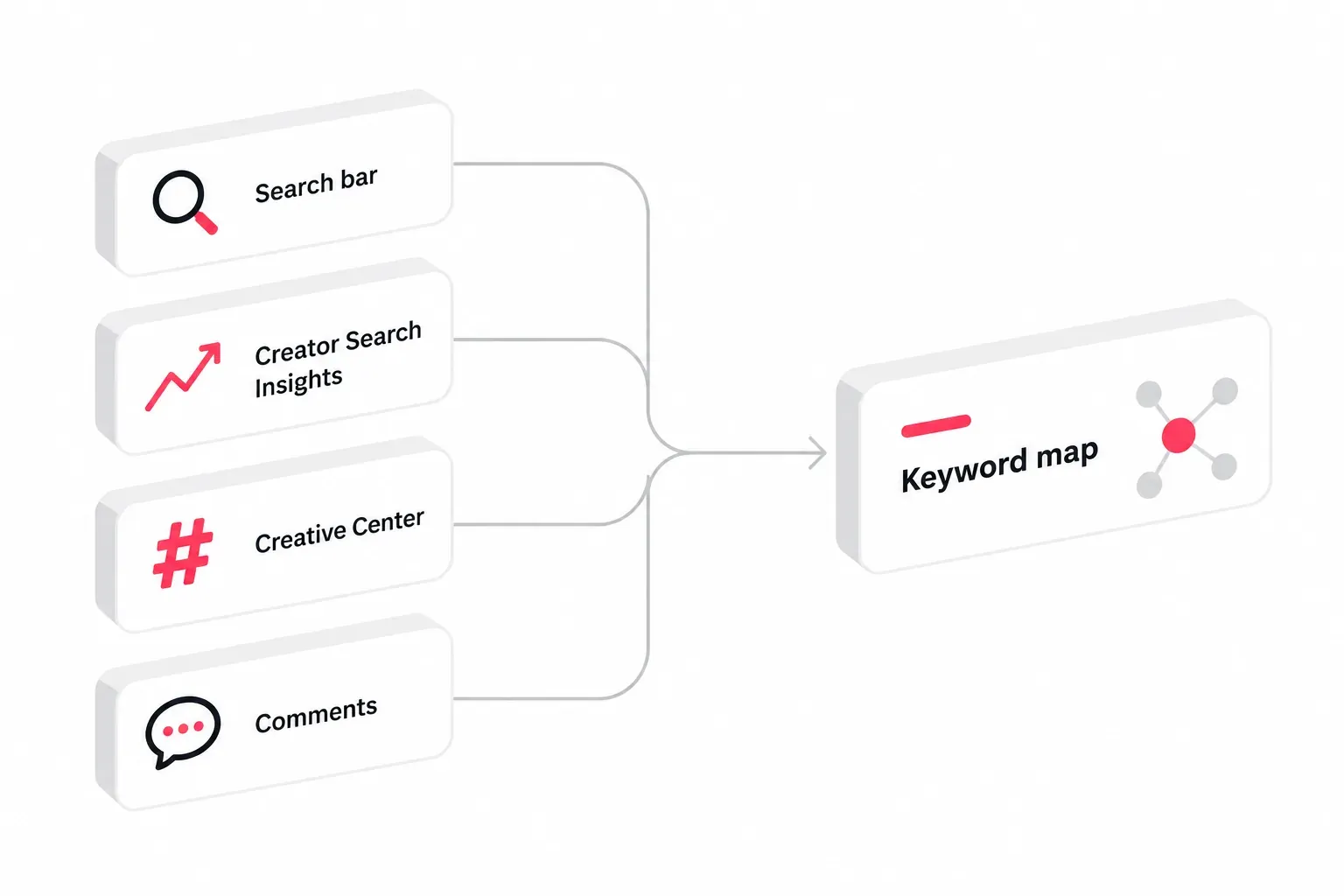
1. The search bar, used like a pro
It’s the fastest free tool you have, and most people type one word and stop.
Type your topic, then pause. Don’t press search yet. The list under the bar is real searches, ordered by how often people run them. That order is signal. The first suggestion is the most common phrasing, not the cleverest one.
Then grow it two ways. Add a space and a letter to extend the front of the phrase, and add words to extend the tail. “Beginner guitar” turns into “beginner guitar s”, which turns into “beginner guitar songs easy”. Add a few more words and you get “beginner guitar songs with two chords”.
Run the letters a to z through your main topic. It takes five minutes and it’s how you surface the long tail nobody else bothers to type out.
Two more things. The related search chips under your results are more real phrases, free of charge. And autocomplete is biased by your account, your region and your past searches, so a clean read on a second account is worth having.
2. Creator Search Insights
TikTok’s Creator Search Insights shows search topics and possible gaps in available content. Searches by followers is a separate filter with its own follower requirement.
Use it to add relevant ideas to your keyword list. Topic popularity does not promise that your video will rank.
The tool also includes search analytics for your posts. Our TikTok Creator Search Insights guide covers access, filters, choosing a content gap, and checking those results.
3. Comments, mined on purpose
Find the top five videos for your topic and read the comments like a researcher. This is the best keyword source on the list and it costs nothing.
Open the comments, sort by top, and search inside them for question words: how, what, where, cost, worth. The top comment is often a joke, so skip it. The real demand is the question asked five separate times, often much further down.
Every repeated question is a phrase someone will type later. Log it in your audience’s own wording. That wording is the part most tools miss. TikTok’s own comment insights can back this up with the phrases your audience uses most.
4. TikTok Creative Center
Free, and no ad account needed. The popular hashtags and topics page runs on real TikTok data and filters by country, industry and timeframe.
Use it as a liveness check, not a keyword source. It tells you whether a topic has energy right now. Trending tags burn out in weeks. Problem phrases stick around for a long time, and those are the ones worth a video.
5. Google, YouTube and forums
If people search a question on Google, they search it on TikTok too, especially when they want to see it done.
YouTube autocomplete works exactly like TikTok’s, so drop the same phrase into both and compare. Google Trends is free, and their Trends help page shows how to read the graphs without misreading the relative numbers. Trends is best for one job here: timing. It tells you when a seasonal phrase starts climbing so you can publish before the rush.
Forums are the last stop. Searching a topic on a forum gives you the exact words people use to describe their problem, and that wording belongs in your video.
The math that makes the long tail win
Here’s why you should stop chasing big phrases.
One broad phrase like “cooking” has millions of videos. You won’t rank for it, and even if you did, that searcher is vague.
Twenty specific phrases like “meal prep for one person on a budget” each have fewer searches and far fewer videos. You can actually rank. And those searchers are qualified, so they watch longer, which tells TikTok your video is worth showing to more people.
Twenty small phrases that rank beat one big phrase you never crack. They also stack. A batch of related videos teaches TikTok what your account is about, and that lifts how your whole account shows up in search.
| Approach | Competition | Watch time | What happens |
|---|---|---|---|
| One broad phrase | Massive | Lower | You get buried, then give up |
| 20 specific phrases | Small | Higher | Each one ranks and keeps pulling views |
The four kinds of search (and the video each one needs)
Not every search wants the same video. The wording tells you what they want, and your first three seconds have to match it or they scroll.
| Kind of search | Wording clue | What they want | Make this |
|---|---|---|---|
| Problem | “how to”, “fix”, “why” | The fix, fast | Open on the problem, show the fix, skip the intro |
| Compare | “vs”, “or”, “which” | A decision | Put both side by side, then give a verdict |
| Cost | “how much”, “how long”, “price” | A number | Say the number in your first line |
| Proof | “worth it”, “is it good”, “review” | A verdict they can trust | Show the real result, then a clear yes or no |
The mistake is treating them the same. A cost searcher who has to sit through your intro leaves. A problem searcher who hears your life story leaves. When they leave early, completion drops, and completion is what decides your rank.
Match the shape of the video to the kind of search and the rest gets easier.
How to do TikTok keyword research: the four step system
Most people stop after step one. They build a list, feel productive, and never touch it again. A list is not a plan. Run the loop instead.
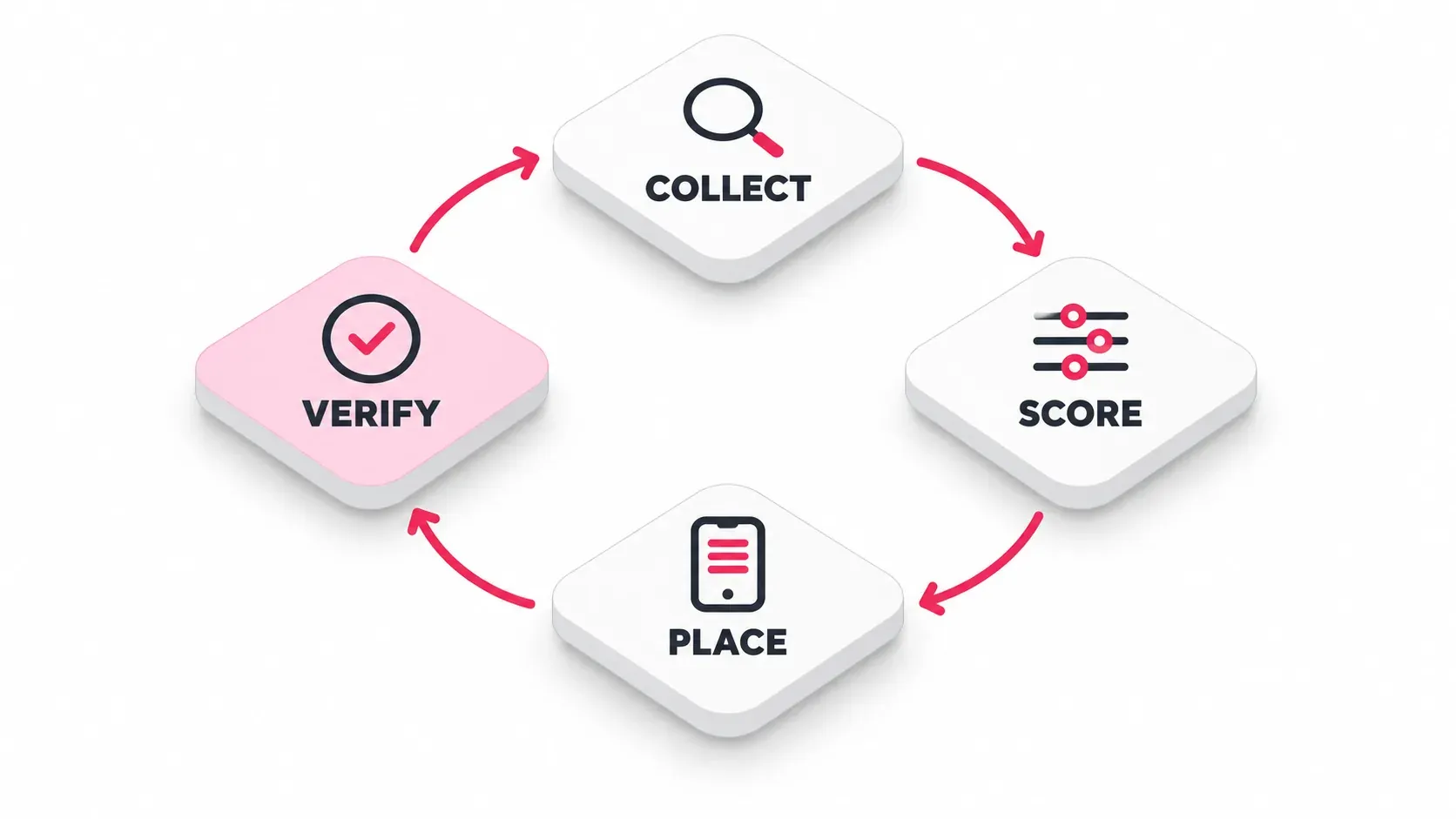
| Step | What you actually do | Time |
|---|---|---|
| Collect | Pull 20 to 40 phrases from all five sources into one notes file | 15 min |
| Score | Rate them, cut the weak ones, keep the top five | 10 min |
| Place | Work the winner into the four spots TikTok reads | while you film |
| Verify | Check search terms and search views a week later | 5 min |
Score a phrase with three questions
Score every phrase from 1 to 3 on three things. Double the first one, because it’s the gate.
Intent. Is this person solving a problem, or just killing time? “Protein pancakes without protein powder” is a real problem. “Food tok” is a vibe. If intent is low, stop scoring. A phrase can’t save a video nobody needed.
Openness. Search the phrase yourself. Big accounts with recent videos mean a crowded result. Small accounts and older videos mean there’s room.
Fit. Can you beat what’s already there, and can you answer it in under a minute? If not, move on. There’s no prize for ranking on a question you can’t answer well.
So the range is 4 to 12. Double intent gives you 2 to 6, then openness and fit add 1 to 3 each.
| Score | What it means | What to do |
|---|---|---|
| 10 to 12 | Strong on every count | Film it today |
| 8 to 9 | Solid, one soft spot | Film it this week |
| 6 to 7 | Thin, worth a cheap test | Make something short, don’t overinvest |
| Under 6 | Weak | Park it, don’t delete it |
Here’s a worked shortlist:
| Phrase | Intent x2 | Openness | Fit | Total |
|---|---|---|---|---|
| protein pancakes without protein powder | 6 | 2 | 3 | 11 |
| easy high protein breakfast | 4 | 1 | 2 | 7 |
| protein pancakes | 2 | 1 | 1 | 4 |
Two rules for the ties. If phrases score the same, pick the one that finishes a series you already started. If it’s still tied, pick the one with the more specific problem.
Then split them by staying power. A problem phrase keeps pulling views for months. A trend phrase spikes and fades. Score a trend phrase high only if you can film it fast, because the window is short.
Worth filming
- A question with a clear answer
- Page one is old or off topic
- A phrase you can answer in 30 seconds
- A question your comments keep asking
- A gap Creator Search Insights shows
Leave it alone
- One popular word like "food"
- A phrase owned by huge active accounts
- A topic you know nothing about
- A question page one already nailed
- A trend you cannot film this week
Where a keyword belongs, ranked by impact
Finding the phrase is half the job. The other half is making sure TikTok can read it. This part stacks, so use every spot you can.
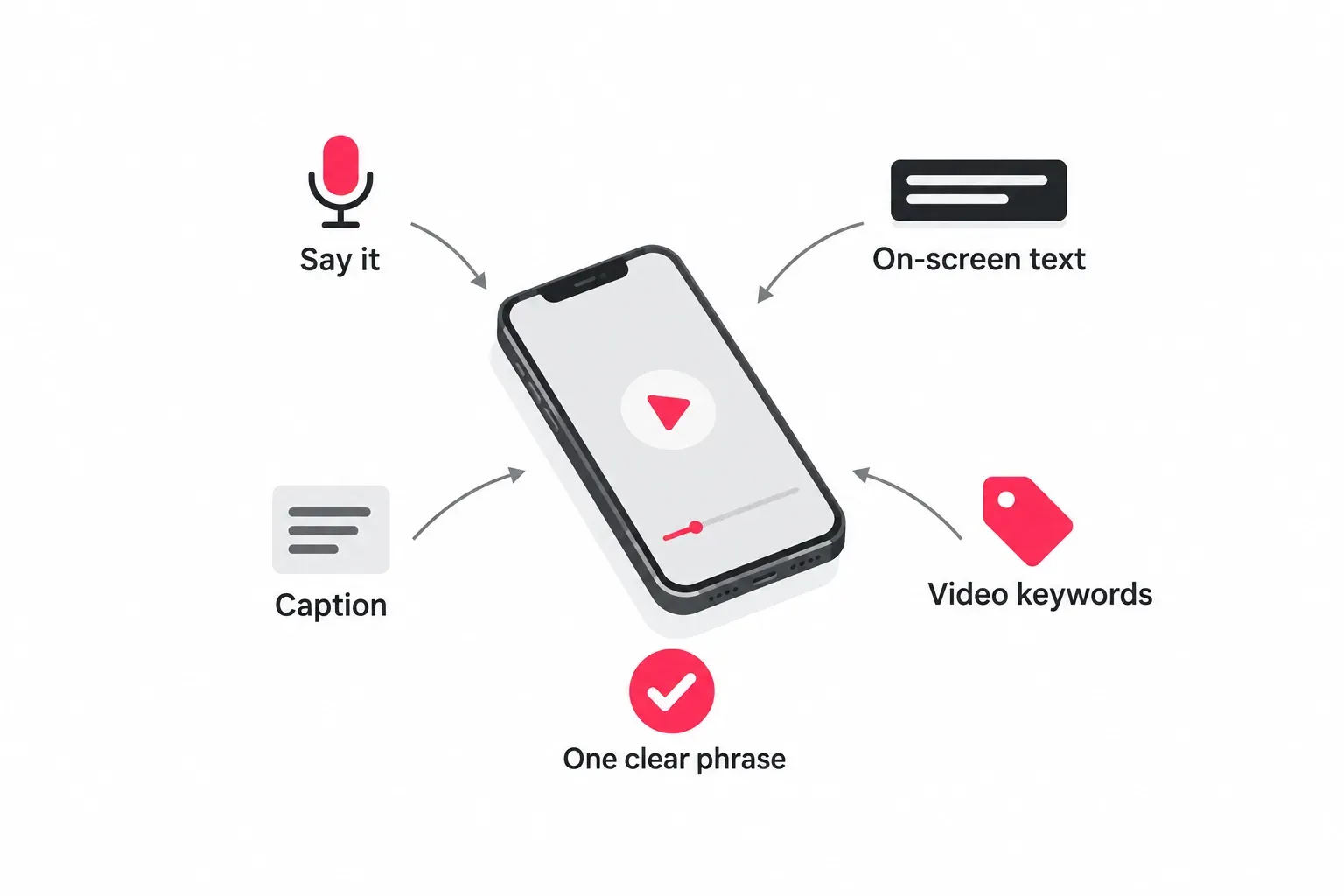
| Spot | Why it counts | What to do |
|---|---|---|
| Spoken words | TikTok transcribes speech, so what you say carries the most meaning | Say the phrase in a normal sentence in the first few seconds |
| On screen text | The platform reads the text on screen too | Put the phrase on a title card and hold it about two seconds |
| Caption, first line | Only the opening words show before the “more” cut | Front load the phrase, then add your detail |
| Video keywords | An official field TikTok added for exactly this | Add your main phrase first, then close variations |
| Hashtags | The weakest signal of the five | 3 to 5 tags: one broad, two niche, one branded |
The video keywords field is the one most people miss. TikTok explains it in their guide to adding keywords to your video. It takes ten seconds and tells the platform what the video is about in plain words.
Two things to avoid. Don’t shout the phrase or cram it in, because it sounds unnatural and unnatural kills watch time. And don’t make two videos for the same phrase, because they end up fighting each other for the same spot. Build one strong video for the phrase, then thinner videos for the questions around it.
Say the phrase once, clearly. We’ll get to why that’s the right number in a minute.
Test a TikTok keyword in five minutes before you film
This is the step almost nobody does, and it’s the one that stops you filming a video nobody is looking for.
- Type the exact phrase and search it.
- Read page one. Look at the account sizes under the names. Small accounts ranking means the door is open. Nothing but huge accounts means it’s crowded.
- Look at the dates. If the newest good result is months old, that query is under served.
- Look at the formats. If everyone does talking head videos and you can demo the answer, that’s your way in.
- Check the related search chips for your next phrase.
- Make the call. Film it, make the phrase more specific, or drop it.
The keyword myth that’s costing you time
You’ve seen it. Use your keyword seven times in the caption. It came from old advice for a different platform, and on TikTok it does nothing except make you sound strange.
TikTok says its recommendations run on watch time, completion, replays, shares and comments. Keyword density isn’t on the list. You’ll find the same signals in their own newsroom explanation of how videos get recommended.
So say the phrase once, the way a person would. Put it on screen. Work it into the caption. Then get on with the video, because how long people watch decides how far it travels.
Simple rule. One phrase, one natural sentence, once.
How to tell if a keyword actually worked
Open TikTok Studio, then Analytics, then Content. Pick the post and look at where the views came from. Search shows up as its own source once a video starts getting found that way, and TikTok’s analytics guide explains where each number lives.
| Signal | Where to look | What good looks like |
|---|---|---|
| Views from search | Post analytics in Studio | Still climbing after day three, not just a first day spike |
| Topic interest | Creator Search Insights topic details | Relevant demand to investigate, not proof your post ranks |
| Watch time and completion | Post analytics | Steady or rising while search views grow |
| Follow up questions | The comments | A sign the video nearly answered it, and your next keyword |
Read the fields available for your post and selected dates. Creator Search Insights includes All posts and Inspired posts analytics, but a topic’s popularity does not tell you where your video ranks. Read search traffic and viewing response together.
If your numbers look frozen rather than slow, that’s a different problem with its own fixes. Our guide on TikTok views dropping walks through the kinds of drop and what each one means.
Then recycle. Take the winning phrase, pull the next question out of the comments, and build two more videos around it. One good keyword becomes a small series that keeps getting found.
A weekly routine that takes 30 minutes
Thirty minutes a week keeps the list alive. Put it on your calendar and stop treating this like a big project.
| When | Task | Time |
|---|---|---|
| Monday | Add 10 phrases from the search bar, comments and Creator Search Insights | 15 min |
| Tuesday | Score them, cut anything weak, pick the top one | 10 min |
| Filming day | Work the winner into all four spots | normal edit time |
| Next Monday | Check search terms and search views, keep the winners | 10 min |
The list is the real asset. After a month you have a map of what your audience asks for, and video ideas stop being a coin flip.
When keywords aren’t enough
Keyword research solves discovery for people who are already searching. What it can’t do is give a video its first push.
Every post starts on a small test group. If they scroll past, the video stays small, no matter how well it matched a phrase. Good keywords get you found. They don’t create momentum.
That gap is about reach, and it’s why the second half of a serious TikTok plan is giving every video a floor of views it can build from. For us, that means running mobile ad placements that put eligible public videos in front of viewers outside TikTok while they’re still fresh, so the platform sees new watch time and likes to work with. You can read how automatic TikTok promotion works and see how a plan is priced. If you post as a creator, our page on automatic promotion for creators shows what a month of it looks like.
If you’re still deciding whether to pay for reach at all, we covered what Promote really costs and whether it’s worth it. Our TikTok growth strategy guide ties content, search and promotion together, and the promotion alternatives comparison lines up every method side by side.
When you’re ready for a plan that matches how often you post, the one minute quiz builds one for you.
The short version
- TikTok runs two systems. The feed tests your video. Search rewards the best match, and it fades slower.
- Keywords come from the search bar, Creator Search Insights, comments, Creative Center, and Google, YouTube or forums.
- No tool has real TikTok search volume. Test phrases by hand instead.
- Score each phrase on intent, openness and fit, then film the winner.
- Go specific. Twenty small phrases beat one big one.
- Match the video to the kind of search: problem, compare, cost or proof.
- Say it, show it, caption it, then add it in the video keywords field. Hashtags last.
- Say the phrase once. Watch time moves rank, not repetition.
- Check search views after a week and recycle the winners into a series.
Frequently asked questions
Is TikTok SEO a real thing or just another trend?
Real, and smaller than the hype. TikTok runs a search engine, and it explains the basics in its own help pages. What isn't real is the idea that one keyword pushes you into the For You feed. Search gets you found by people who are already looking for that topic. The feed decides the rest.
How do I find keywords on TikTok for free?
Start with the search bar. Type your topic and read the suggestions before you press search. Use Creator Search Insights to explore related topics and possible content gaps. Then read questions in the comments on relevant videos. Compare those sources before choosing a phrase to test.
How many times should I use a keyword in a TikTok video?
Once, in a normal sentence. Say it near the start, put it on screen, and work the same phrase into your caption and the video keywords field. Repeating it seven times does nothing for rank and makes people scroll away. Watch time is what moves you up.
Why is my video not showing up in TikTok search?
Three common reasons. The phrase you're chasing isn't what people type, the video is too new for TikTok to index it yet, or the post isn't eligible for recommendations. Search your exact phrase yourself, then check again after a few days.
Do hashtags still matter for TikTok keyword research?
A little, and less than most advice claims. Hashtags park your video near a topic. The words you say and show put it inside a search result. Use a few relevant tags at the end, never as the whole plan.