
TikTok Target Audience: Find Yours and Test What Works
Find your TikTok target audience with a practical research and testing method. Learn which viewers matter, what your data can show, and when to pay for reach.
On this page
More views can mean less progress when the wrong people are watching.
How do you find the right TikTok target audience?
Your TikTok target audience is the group most likely to care about your work and take the next step you want. Find them by testing which posts draw that response.
Start with the next step
For a musician, that step is hearing the full song.
Say a pedal demo gets 20,000 views and two questions about the song. A song story gets 2,000 views and eight song questions.
The smaller post is a better lead for finding listeners. Song plays still need checking.
What You’ll Learn
- Pick a group by the action they can take.
- Find clues in real questions and TikTok Studio.
- Compare posts by useful response, not only views.
- Test a new audience idea when the wrong people show up.
- Know when added reach will help you learn more.
Who is TikTok’s target audience?
TikTok has viewers across many ages and interests. Those broad numbers can show that your group is on the app. They cannot tell you whether your posts reach that group or lead to a result you want.
Pew Research Center asked U.S. adults whether they use TikTok:
| Age | U.S. adults in that age group who use TikTok |
|---|---|
| Under 30 | 63% |
| 30 to 49 | 44% |
| 50 to 64 | 30% |
| 65 and older | 12% |
In DataReportal’s snapshot of TikTok ad data, adults ages 25 to 34 are the largest group advertisers could reach worldwide.
Pew shows what share of each U.S. age group uses TikTok. Ad reach estimates how many adults an ad may reach. Neither tells you who watched your post. Check the country, date, and what a number counts.
Two 28-year-olds can like the same music. One wants songs; the other wants to learn production. Age alone won’t pick your next video.
What does the right audience look like for your account?
The right audience has a need you can serve again and again, in a place where they can take the next step you want. Think through the path from a possible viewer to a useful result.
| Group | Question it answers | Evidence to check |
|---|---|---|
| People you could serve | Who needs this and can act on it? | Customer questions, search terms, service area, where your work is sold |
| People your posts reach | Who is seeing the work now? | Viewer data and post results in TikTok Studio |
| People who want more | Who asks, saves, follows, or comes back? | Comments, saves, post follows where shown, repeat questions |
| People who act | Who streams, books, buys, or signs up? | Your own site, sales, booking, or music data |
A viral clip can reach people who never want another post. A small one can bring buyers. The table shows where the gap sits, though you still need to learn why.
Here is a working brief for a musician who wants more listeners:
| Decision | Working answer |
|---|---|
| Main group | People who like quiet alternative rock with story-led lyrics |
| What they want | A song that puts a feeling into words, plus more songs like it |
| Where they can act | Countries where the song and listening link work |
| What the creator can show | Chorus clips, live takes, and the story behind a line |
| Next step | Hear the full song, then come back for the next release |
The brief is a bet to test. Gear fans may love the account too. If you want listeners, judge song posts by listener response before you make a month of pedal lessons.
Ask: Can you make ten useful posts for this group? If not, the need may be too narrow. If yes, the TikTok growth strategy guide can help turn it into a series.
Where can you find evidence about your audience?
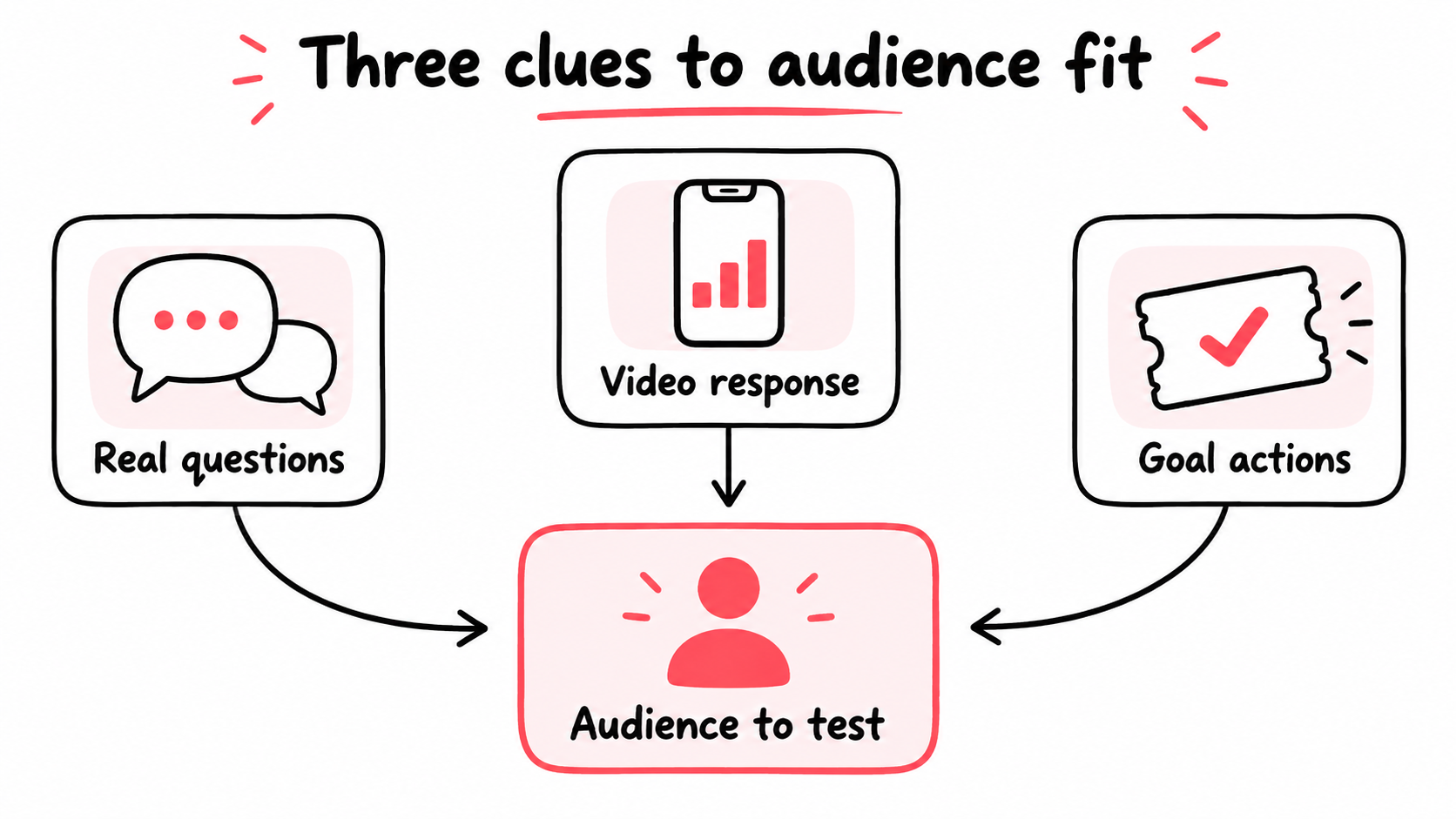
Use three sources: questions from people who can act, public talk in your niche, and your own TikTok results. A repeated question across those sources is a stronger lead than one viral comment.
Start with people close to the goal
Read ten recent messages, sales calls, order notes, or replies. Copy the words people used. Mark whether each person was a buyer, a peer, or just curious.
That last mark matters. A cake buyer asking whether you can deliver on Saturday has a different need from another baker asking for your frosting recipe. Both questions can make good videos. Only one is tied to a cake order.
If you have few messages, ask customers what they needed to know before choosing you. Ask about that real choice, not a video they might watch someday.
Check the public conversation
Search for a need, such as “songs about leaving home” instead of “music.” Open five strong results and a few recent ones. Note unanswered questions and whether those people would want more of your work.
Those comments give you language and ideas to test. They are not a poll of everyone on TikTok.
TikTok’s Comment insights can group questions where the feature is available. Read the comments behind its summary. Creative Center Trends can show where a topic is active, but a busy topic may still draw the wrong people.
Focus on who needs the answer. The TikTok keyword research guide helps compare phrases; the Creator Search Insights guide covers search gaps.
Read your own results with care
Open Profile → Menu → TikTok Studio → Analytics. Check Viewers and Followers. Save the date range and any age or location data shown. TikTok’s Studio guide describes the sections; what you see can vary by account.
For posts in that period, note the topic, opening, traffic source, and paid status. An account-level viewer chart covers many posts; it cannot show that one clip changed your audience. The TikTok analytics guide explains the reports.
For another creator, you can review public posts with the TikTok profile analyzer. It cannot show private viewer ages, watch time, or traffic sources.
How do you turn audience research into videos?
Name the viewer’s need or location in the first seconds. Show the answer or result before asking for a follow, visit, or sale.
| Viewer you want | Opening that helps them self-select | What to show | Response worth watching |
|---|---|---|---|
| Listeners for a new song | “I wrote this after moving away from home.” | The chorus, then the line that started it | Questions about the full song, song plays, follows |
| Guitar players who want a lesson | “Here’s the chord change behind that chorus.” | Your hands making the change at normal speed | Questions about playing it, saves for practice |
| Buyers for a local bakery | “Need a birthday cake in [your city] this weekend?” | A finished cake, size, pickup area, and how to order | Local inquiries and orders |
The guitar lesson may win on views and still tell you little about song listeners. The bakery clip may travel less far, yet one local order can make it more useful.
Use words from real questions, not borrowed slang. Make the next step real. If the song is not out, say when and where listeners can hear it.
Which TikTok numbers show audience fit?
Read your numbers in order: delivery, response, then the action you care about. Each tells you something useful, but none can stand in for the next one.
| Stage | What to check | What it can tell you | What it cannot prove |
|---|---|---|---|
| Delivery | Views, main traffic source, viewer location where shown | Whether the video reached people and where they came from | That those people wanted more |
| Response | Watch time, saves, shares, specific comments, post follows where shown | Whether viewers cared about this post or asked for another | That they bought or listened to the full song |
| Action | Link visits, streams, inquiries, bookings, sales | Whether people took a step tied to your goal | That one post caused every action without a way to track it |
Keep the sources separate when you bring in viewers from elsewhere. An ad report can tell you what you spent and how many people visited the video. TikTok Studio shows what happened on the public post. Your store, booking tool, or music dashboard records later actions. Those are different events, not one big “engagement” number.
Decide what counts as a useful response before you read the comments. For our musician, “Where is the full song?” counts as a listener question. “Which pedal is that?” counts as a gear question. Both are real interest, but they serve different goals.
When posts get very different reach, count those questions per 1,000 views as well as in total:
Listener questions ÷ views × 1,000 = listener questions per 1,000 views.These made-up numbers show how the math works.
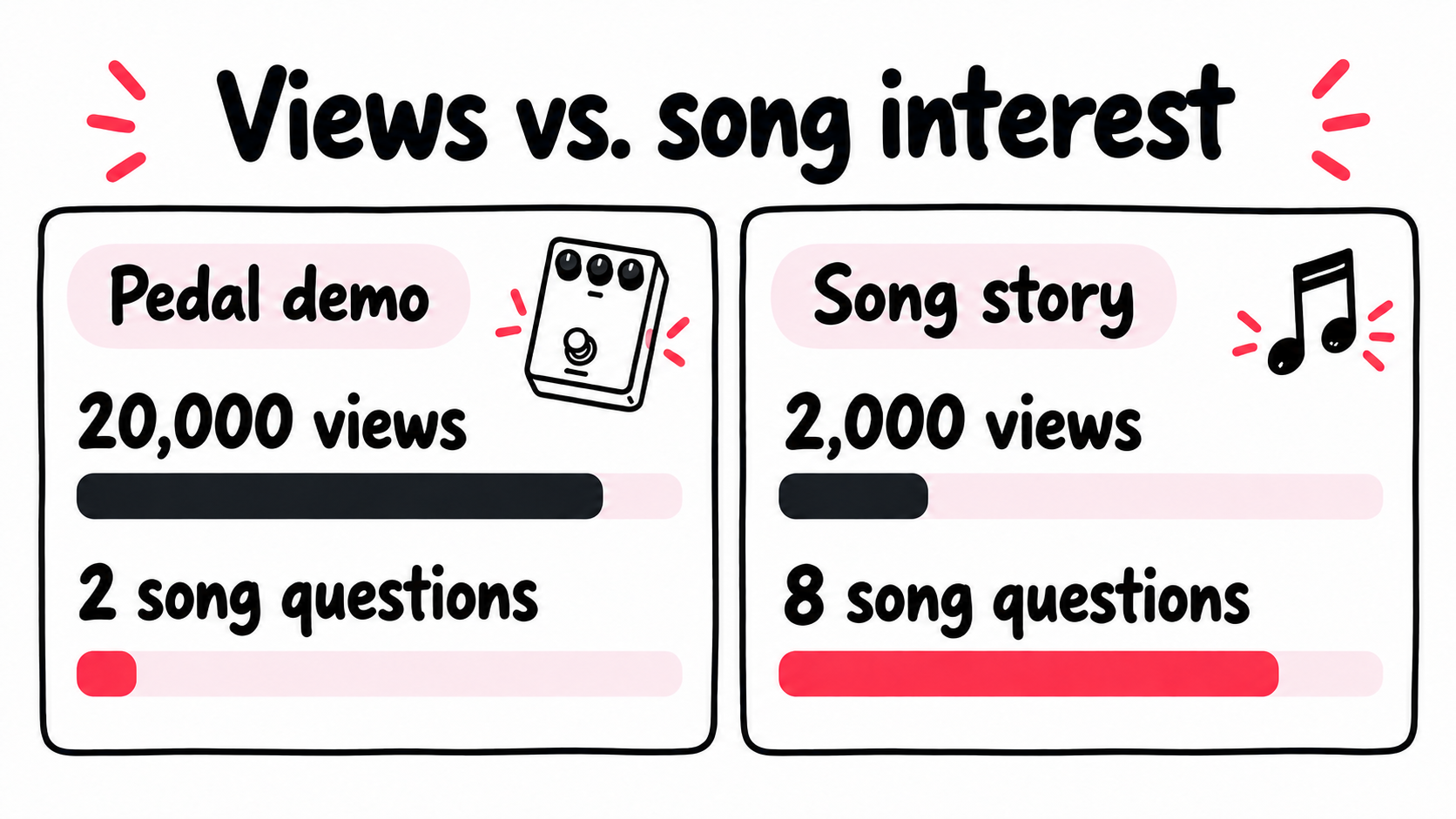
That is 0.1 versus 4 listener questions per 1,000 views. The song story got four times as many listener questions with one tenth of the views. Test it again, then check song plays if you can. Keep the raw counts beside the rates; one comment can swing a small sample.
Use post-level follows only where shown. Do not credit all new account followers to one clip. Leave missing fields blank.
How do you test an audience idea without fooling yourself?
Write down what would change your mind, then give each idea several fair chances. A single post can rise or fall for many reasons besides the audience you hoped to reach.
- State the idea and the goal. “Song stories will bring more listener questions than gear demos” is a claim you can check. “Grow my audience” is too broad.
- Make a small set for each need. Try three song stories and three gear clips. Keep the effort, length, and posting conditions as close as you can. Keep paid posts out of this first set.
- Log the same facts for every post. Note the opening, topic, date, views, traffic source, useful questions, post follows where shown, and any later action you can track. Check each post at the same age, such as seven days.
- Read the pattern, then make the next set. If two or three song stories bring listener questions, make three more. If only one does, look at what that post promised before you claim the whole idea works.
TikTok may show each post to different people. Treat a pattern as a lead, then test it with another set.
If the right viewers watch but few follow, check the promise on your profile. The views but no followers guide goes deeper. If useful questions arrive but reach stays small, test the same idea with a small, steady budget across several new posts.
What if TikTok shows your videos to the wrong audience?
Find where the mismatch starts: location, topic, response, or the next step. Then change the part you can affect. One off-topic hit is not enough reason to wipe an account and start over.
| What you see | Check before you decide | Next test |
|---|---|---|
| Recent viewers live where you cannot sell | Check the dates and location data in Studio. Are several posts affected or only one? | Name the city or service area in the opening and profile. Review another set of posts |
| A viral gear clip draws followers who ignore your songs | Check new song posts, not the account’s all-time follower mix | Post a run of song clips with a clear listening path. Watch for listener questions and follows |
| Peers praise your work, but buyers do not inquire | Ask whether the clip teaches peers or helps a buyer make a choice | Show the result, price range, fit, or next step a buyer asked about |
| People watch but do not take the next step | Check whether the profile and offer match the video | Fix the path after the video before changing your whole audience |
| Comments bring unwanted attention | Check whether those replies reflect any audience you want | Use TikTok’s comment controls. You owe no reply for the sake of reach |
Old followers stay on the account, so the follower mix can lag. Judge recent posts. A second account may help if your topic or language has changed completely; one broad hit is not enough.
TikTok says recommendations use viewer actions, video details, and user information. It does not offer a fixed reset time. VPN tricks, an exact hashtag count, or a posting streak cannot promise a chosen audience. If reach, watch time, and follows all look off, use the TikTok growth audit to find the first weak step.
When should you pay to reach more people?
Add reach after several posts draw the right questions but too few people see them to trust the pattern. The budget should help you learn whether that response repeats with more viewers.
Give the whole idea a fair test
Make three new posts for the same group. Set a small budget for each and keep the country the same. Start while each post is still new, then check them at the same age. Equal budgets do not create equal reach, but they remove one reason a post might get less of a chance.
Do not back only the early view winner. In our music example, the pedal demo might win that race and hide the song story that brings listener questions.
One route is TikTok Ads Manager, where you can use broad or narrower audience settings. Another is advertising the public post in other mobile apps and sites. Someone sees the ad, taps, and lands on the TikTok video you posted. That gives the post another source of discovery, but it does not guarantee those people want your song or product. Audience Insights gives group estimates, not your follower list.
Check what the new reach bought
For each post, log ad delivery (spend and visits to the video), TikTok response (views, goal-linked questions, follows where shown), and your goal data (song plays, bookings, or orders). A visit to the video is not a TikTok view; a view is not a sale. Public views can also come from TikTok while an ad runs. Compare spend with useful questions and actions, but only call it cost per action when you can trace the action to the campaign.
Repeating the setup for each post takes work. A process that picks up each new public post and reports on it separately keeps the test consistent as you publish.
If you serve only one city, country-level reach may be too broad. Choose a method with city-level control. If you cannot yet name the viewer, video, and action, save the budget until you can.
Frequently asked questions
How do I find my target audience on TikTok?
Start with people who can take your next step, such as placing a local order or playing your song.
Collect their questions from messages, search, and comments. Make three posts around one question, then compare useful replies and actions, not just views.
How do I check my audience on TikTok?
Open TikTok Studio → Analytics → Viewers. Note the date range, location, and age data shown for your account.
Then check the posts from that period. The Followers tab describes followers; it does not tell you who watched any one video.
How does TikTok choose who sees my videos?
TikTok says its recommendations use viewer actions, video details, and user details such as language and location.
Make the topic clear in your opening and caption, then check how viewers respond. No hashtag lets you choose a fixed organic audience.
How do I change my target audience on TikTok?
You cannot change the audience for organic posts with a setting. First check whether several recent posts show the same mismatch.
Make a short series for the new group, with their need or location clear in the opening. Judge those posts on their own; old followers remain in your account total.
Should I let TikTok choose my audience?
For organic posts, you do not pick exact viewers. For ads, set essential limits, such as a place you can serve, then compare automatic and custom targeting if your campaign allows it.
Use the same video and goal. Judge useful inquiries or sales, not just cheaper views.